

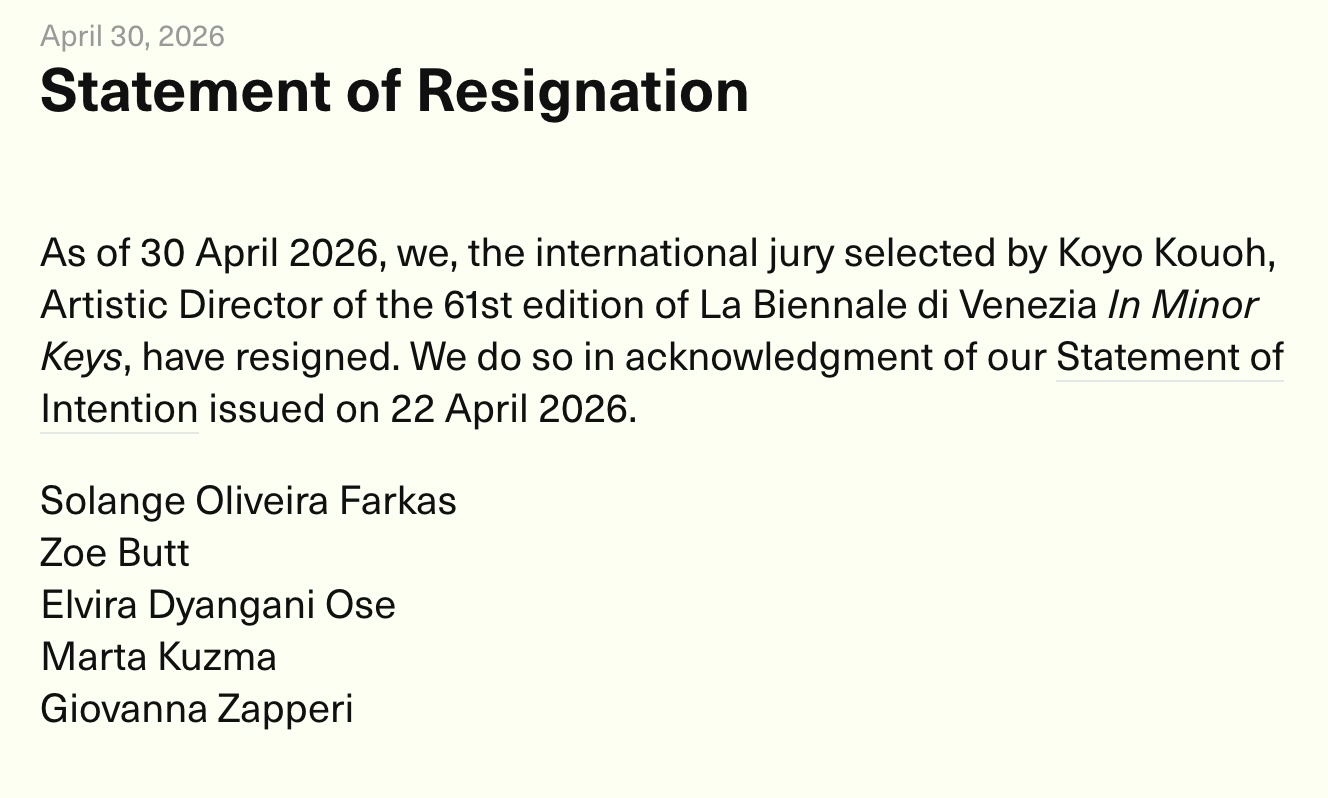
The international jury of the 61st Venice Biennale resigned en masse today, just nine days before the exhibition opens — and within hours, the Biennale announced it would replace the iconic Golden Lion awards with a new prize voted on by the visitors.
The five members — president Solange Oliveira Farkas, Zoe Butt, Elvira Dyangani Ose, Marta Kuzma, and Giovanna Zapperi — published a terse statement on e-flux: “As of 30 April 2026, we, the international jury selected by Koyo Kouoh, Artistic Director of the 61st edition of La Biennale di Venezia In Minor Keys, have resigned. We do so in acknowledgment of our Statement of Intention issued on 22 April 2026.”
That statement of intention, issued eight days earlier, had declared that the jury would not consider for the Golden or Silver Lion any countries “whose leaders are currently charged with crimes against humanity by the International Criminal Court” — a criterion that effectively singled out Russia and Israel.
In response, the Biennale announced that visitors to the exhibition will now select the winners of two awards: Best Participant in the main curated exhibition In Minor Keys, and Best National Participation among the 100 national pavilions. Any ticket holder who visits both the Arsenale and the Giardini will be eligible to vote, with attendance at both venues verified through the ticketing system. The new prizes will be known as the “Visitors’ Lions” and awarded on the closing day, 22 November.
The shift is not politically neutral. The Biennale’s statement specifies that all national participations on the official list are eligible for the Visitors’ Lion for Best National Participation, “following the principle of inclusion and equal treatment among all participants” — a direct rebuttal of the jury’s decision to exclude Russia and Israel.
The political reaction was swift. Italian Prime Minister Giorgia Meloni reiterated that the government had not agreed with the decision to allow Russia to participate, but acknowledged the Biennale’s autonomy, and said she did not know whether the resignations were connected to the Culture Ministry’s decision to send inspectors to Venice. Deputy Prime Minister Matteo Salvini was more openly enthusiastic, calling it a “great idea” to let spectators decide the winner rather than a jury.
The resignations and new prizes are the latest convulsions in what has become one of the most turbulent editions in the Biennale’s 130-year history.