

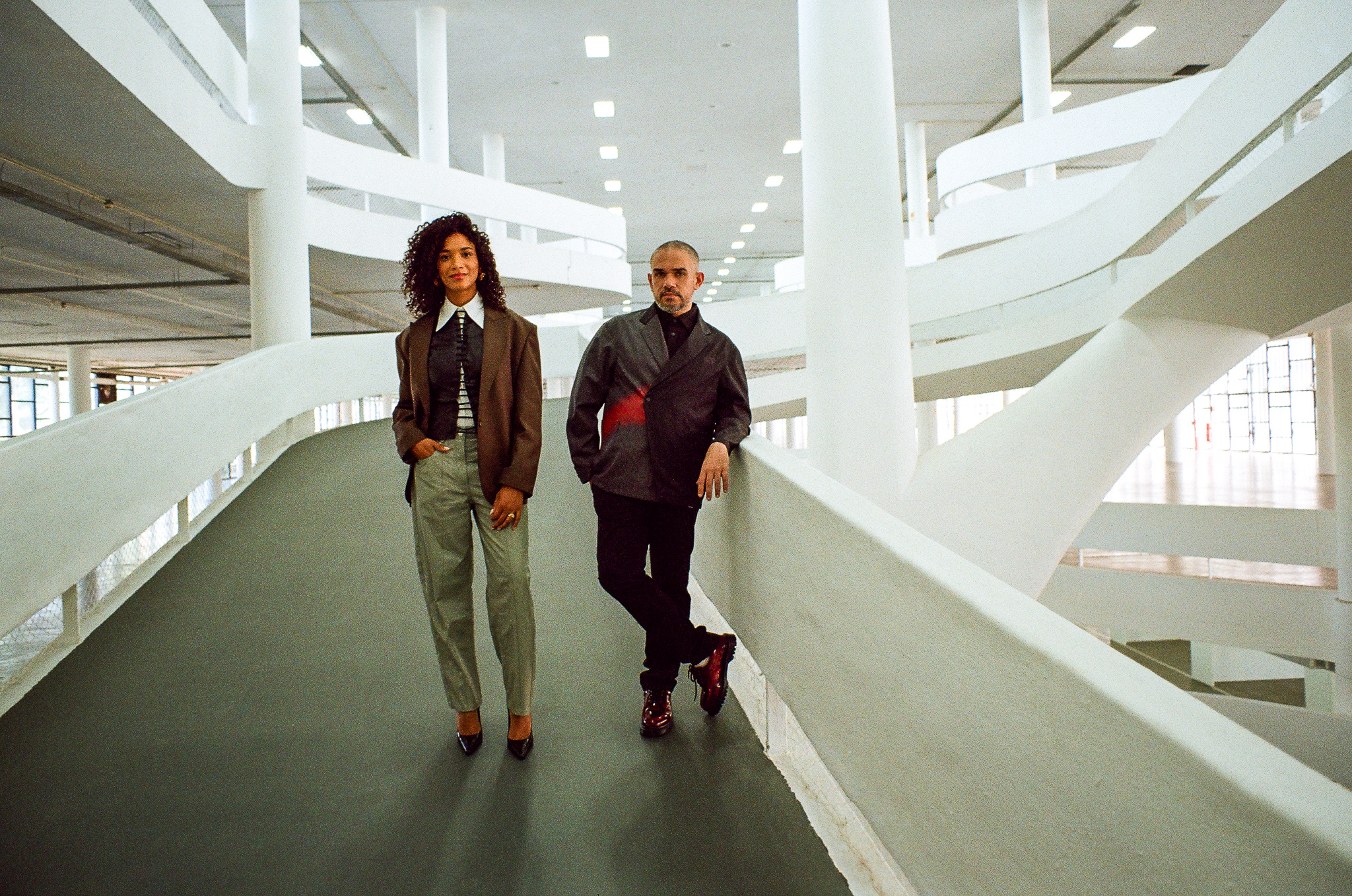
The Fundação Bienal de São Paulo announces Amanda Carneiro and Raphael Fonseca as chief curators of the 37th Bienal de São Paulo. Scheduled to take place in 2027 at the Pavilhão Ciccillo Matarazzo in Ibirapuera Park, the Bienal de São Paulo is the largest visual arts event in Latin America and one of the most important in the world.
Amanda Carneiro and Raphael Fonseca are internationally acclaimed curators from Brazil. Since 2018, Carneiro has been a curator at Museu de Arte de São Paulo Assis Chateaubriand (MASP). She was an artistic organizer at the 60th International Art Exhibition of the Venice Biennale (2024) – Stranieri Ovunque – Foreigners Everywhere. Raphael Fonseca is a visual arts curator at Culturgest, which has offices in Lisbon and Porto, Portugal. He is curator-at-large for Latin American modern and contemporary art at the Denver Art Museum in the United States, and curator of the Taiwan Pavilion at the 61st Venice Biennale (2026). He is a member of the curatorial group for the 3rd Counterpublic Triennial (2026) and is one of the co-curators of the Sequences festival in Reykjavík, Iceland, in 2027.
“I have long been shaped by the artistic practices, debates, and encounters made possible by the Bienal de São Paulo. I am honored by this appointment as chief curator and moved by the possibility of developing this edition in São Paulo, a city that is also my own. I am equally glad to partner with Raphael Fonseca, a longtime friend and collaborator, and with a curatorial team whose research interests match the scale and complexity of one of the most important platforms for contemporary art. Taking on this project is, at once, a joy, a challenge, and a responsibility. I am excited to work with artists to develop the projects, questions, and forms of engagement that will shape it, and to collaborate closely with the Bienal team throughout the process. For this unique opportunity, I am grateful to the president of the Fundação Bienal de São Paulo, Andrea Pinheiro, as well as to the institution’s Governing Board,” says Amanda Carneiro.
“The first time I traveled from Rio de Janeiro to São Paulo was in 2006, precisely to see a visual arts biennial for the first time—the 27th Bienal de São Paulo,” recalls Raphael Fonseca. “To be in the position of chief curator twenty years after that first encounter with the biennial format is something that exceeds any of my expectations and leaves me, frankly, speechless. Also, being able to work on a project of this scale with Amanda Carneiro—someone with whom I’ve collaborated numerous times and who, more than just a co-curator, is part of my family of friends—makes me even more excited. I can’t wait to start solidifying our ideas together with our curatorial team, the artists, and the various teams of professionals who make up the Fundação Bienal de São Paulo. I am very grateful for the trust and the opportunity granted by the institution’s presidency and its Board” he says.
“The Bienal de São Paulo has over seventy years of history, and over that time has undergone profound transformations in the way it approaches curation, the public, and its role in the world”, notes Andrea Pinheiro, president of the Fundação Bienal de São Paulo. “The selection of Amanda Carneiro and Raphael Fonseca for the 37th edition is part of this evolving history. For the second time, two Brazilian curators are taking on, together and on equal footing, the artistic leadership of an edition. It is a decision born of a careful, collective selection process and a clear conviction: that there exists, in Brazil, a curatorial generation with the talent, experience, and vision necessary to keep the Bienal de São Paulo at the center of the artistic debate of our time”, she states.
Over the course of recent editions, the Fundação Bienal de São Paulo has explored and experimented with different curatorial models, ranging from international chief curators to collective structures with no defined hierarchy, creating a deliberate alternation between external perspectives and voices rooted in Brazil. In this context, the appointment of Amanda Carneiro and Raphael Fonseca marks a return to a distinctly Brazilian curatorial tradition, while simultaneously placing that tradition in dialogue with contemporary debates and international circuits.
Further details about the 37th Bienal de São Paulo’s curatorial team and concept will be announced in the coming months.
About the selection process
For the second time, the selection of the Bienal de São Paulo’s curators was carried out by a curatorial selection committee led by the president of the Fundação Bienal de São Paulo, Andrea Pinheiro. It was composed of her vice president Maguy Etlin, the members of the Governing Board José Olympio da Veiga Pereira, Ligia Fonseca Ferreira, Marcelo Mattos Araujo, and Susana Leirner Steinbruch, and Pamela J. Joyner, from the International Advisory Board, with secretariat support from the executive superintendent Antonio Lessa. The collegial process considered criteria such as the intellectual consistency of the proposal, the relevance and complementarity of the curatorial trajectories, the ability to engage with the local context and the international circuit, and alignment with the mission and values of the Fundação Bienal de São Paulo.
About the curators
Amanda Carneiro was born in São Paulo, where she currently lives. She has been a curator at the Museu de Arte de São Paulo Assis Chateaubriand (MASP) since 2018. She was an artistic organizer at the 60th International Art Exhibition of the Venice Biennale (2024)—Stranieri Ovunque – Foreigners Everywhere. At MASP, Carneiro has curated a wide range of exhibitions dedicated to modern and contemporary art, many of which were organized in partnership with national and international institutions, such as The Whitworth, the American Folk Art Museum, the Museo Universitario del Chopo, and Itaú Cultural. Among her projects are solo exhibitions by Santiago Yahuarcani (2026); Hulda Guzmán (2025); Serigrafistas Queer (2024); Kang Seung Lee (2024); Beatriz Milhazes (2020–2021); Leonor Antunes (2019); and Sonia Gomes (2018). She has also co-organized exhibitions that have brought to light important 20th-century artists such as Abdias Nascimento (2022), Madalena Santos Reinbolt (2022), and Conceição dos Bugres (2021–2022), as well as group shows such as Histórias brasileiras (2022). She holds bachelor’s and master’s degrees, and is a PhD candidate in social history from the Universidade de São Paulo. She is currently conducting research on the Second World Black and African Festival of Arts and Culture (FESTAC ’77). She was co-editor of the Afterall Journal, where she now serves on the editorial board, and, prior to joining MASP, worked at the Museu Afro Brasil Emanoel Araujo.
Raphael Fonseca was born in Rio de Janeiro and lives in Lisbon. He is a visual arts curator at Culturgest, which has offices in Lisbon and Porto, Portugal. He is curator-at-large for Latin American modern and contemporary art at the Denver Art Museum in the United States, and curator of the Taiwan Pavilion at the 61st International Art Exhibition of the Venice Biennale (2026). He is a member of the curatorial group for the 3rd Counterpublic Triennial (2026) and is one of the co-curators of the Sequences festival in Reykjavík, Iceland (2027). He was chief curator of the 14th Bienal do Mercosul (2025), co-curator of the 22nd Bienal SESC_Videobrasil (2023), and curator of the 1st Bienal do Barro (2014). As a curator, he has collaborated with institutions such as the Galeria Municipal do Porto (Portugal), the Haus der Kunst (Germany), the Museu de Arte do Rio, Framer Framed (Netherlands), the Institute of Contemporary Arts Singapore, and the Centro Cultural Banco do Brasil. He served as curator at MAC Niterói from 2016 to 2020. He holds a PhD in art history and criticism from UERJ, a master’s degree in art history from Unicamp, and a bachelor’s degree in art history from UERJ. He was a visual arts teacher at Colégio Pedro II in Rio de Janeiro from 2010 to 2022.