

The Busan Biennale Organizing Committee has unveiled the venues and a first group of artists and collectives of its 2026 edition. Led by co-artistic directors Evelyn Simons and Amal Khalaf, the exhibition will take place from 29 August to 1 November 2026 under the title Dissident Chorus.
In the port city of Busan, Dissident Chorus is rooted in the belief that sound, like water, resists containment, erodes borders, and carries memory without permission. It invites audiences into a collective performance where voices and sounds overlap and accumulate into a resonant whole. The curatorial theme envisions the exhibition as a choral body – an assembly of polyphonous voices that build together into a living, breathing, resonant composition. The artworks featured in the biennale will vibrate alongside the city’s historical hum and maritime echoes, connecting collective memory with contemporary sensibilities.
“This edition of Busan Biennale is not simply an exhibition about sound, but a rehearsal for other ways of being together,” Evelyn and Amal notes, “To gather in Busan is to stand on ground that has always known sound’s organizing power. From work songs that built a nation to club sounds that forge temporary communities, these sonic practices are bound together by a common pulse: the refusal to be silenced.”
Dissident Chorus presents a field of resonances, a chorus without conductor, a messy aligning of bodies and artistic practices. Moving like sound: appearing, disappearing, and returning, refusing silence, the exhibition insists on presence, and carries the possibility of another future.
Amidst the ruins of speech, Dissident Chorus returns to language’s potential to hold ambiguity, complexity and secrets – to be more unruly than words. The exhibition expands language beyond grammar and sanctioned speech, exploring its positions in gesture, breath, rhythm, and the tremble of bodies held in proximity. Through collective sounding, voices and bodies emerge as alternative political registers. Aligning with Judith Butler’s notion of “bodies in alliance”, the biennale underscores how political agency and autonomy can be reclaimed through presence, and through the act of appearing together.
Expanding to new venues across the city
Busan Biennale 2026 will unfold across three venues across the city, encompassing Busan Museum of Contemporary Art, Former Busan Nam High School and Space OneZ. Former Busan Nam High School and Space OneZ are both located in Yeongdo island, an area shaped by layered histories of port activity, shipbuilding, migration, and settlement.
Former Busan Nam High School carries nearly seventy years of accumulated voices, daily rhythms and collective memory. Vacated earlier this year following the school’s relocation, the site retains traces of education and communal life. These layers bring the changing realities of contemporary Busan into direct conversation with the exhibition. It provides a framework to question modes of education and look into alternative approaches to pedagogy; learning through sound, oral knowledge transmissions and bottom-up archives rooted in dissent.
Located in the dockside area facing Busan North Port, Space OneZ, occupies a former marine-supplies warehouse. Its industrial fabric still holds the memory of circulation, labour and logistics, but also of clandestine club nights, offering a setting where different historical layers and social narratives remain physically present.
First line-up of artists and collectives unveiled
The Busan Biennale Organizing Committee also unveils a first group of participating artists and collectives. Working across installations, sound, performance, sculptures and paintings, they create works that honor the legacies of music and club cultures that intertwined with struggles of liberation, while also looking ahead, imagining how new alliances and frequencies can emerge.
• Julien Creuzet (France), who represented France at the 2024 Venice Biennale, develops immersive installations shaped by the histories and sensibilities of the Caribbean, tracing questions of the sea, migration and identity. His site-specific commission will form a strong dialogue with Busan’s layered histories of the urban, the maritime and the transitory.
• Korean artist Dew Kim has developed a practice that explores religion, fandom, K-pop culture and BDSM and their unlikely intersections, unpacking social norms and structures of power. This approach resonates closely with the exhibition’s interest in voices, experiences and subjectivities that do not easily resolve into harmony.
• Brazilian artist Jota Mombaça works across language and sound, challenging human-centred perspectives through a practice attuned to opacity, resistance and anti-colonial imagination. For this exhibition, Mombaça develops an auditory environment in which human and non-human voices resonate together through underwater acoustics and collective vocalisation in collaboration with music producer Anti Ribeiro.
• Congolese-Belgian artist Nkisi, whose practice engages music and sound, will explore phonograph archives to question colonial dynamics embedded within sound recording.
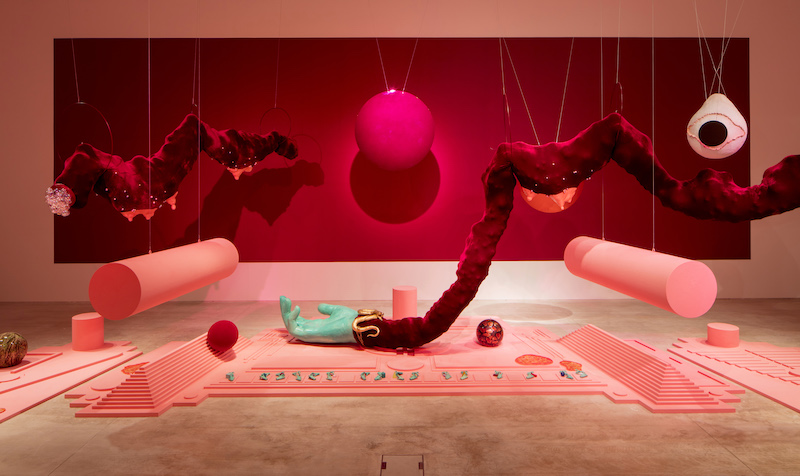
• Joint winner of the 2019 Turner Prize, Tai Shani (United Kingdom), whose work draws on mythic imagination, sci-fi references and feminist aesthetics to question established orders, will offer a richly layered installation in which sensation and voice become intricately entangled.
Photo: David Levene.