As the Venice Biennale opens next week amid cascading crises, the oldest art biennial cannot pretend that culture and geopolitics occupy separate rooms.
The canals will shimmer. The Giardini will bloom. The champagne corks will pop and the preview passes will be triple-scrutinized at the gates, when the 61st edition of the Venice Biennale — the oldest, and the most politically entangled art biennial — will open its doors to the press and professionals on May 6th (and to the public on May 9th) as though it were a normal year.
It is not a normal year.
The controversies surrounding this edition are not incidental to the event. They are the event — or at least its most consequential dimension. Before a single work has been unveiled, the 2026 Biennale has triggered a diplomatic incident involving the European Commission, exposed deep fractures within the Italian government, provoked an unprecedented jury declaration, and brought the grievances of two of the world’s most devastating ongoing conflicts crashing through the doors of the Arsenale. This is on top of the controversies that preceded them: the removal and subsequent reinstatement of Khaled Sabsabi as Australia’s representative, and South Africa’s cancellation of the planned Gabrielle Goliath exhibition.
Understanding what is happening in Venice this May requires understanding what the Venice Biennale, with its archaic structure incorporating national representations, has always been: an eerily accurate reflection of the world outside the Giardini and Arsenale with systemic inequalities, colonial histories, extractivism and competition for power and hegemony.
The Return of Russia
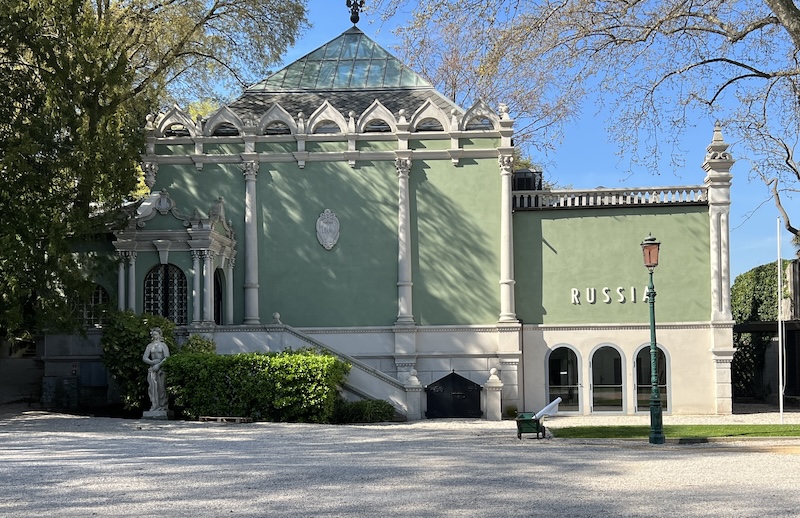
The single decision that set the first controversy in motion was the approval by Biennale Foundation president Pietrangelo Buttafuoco of Russia’s return to the national pavilion it has held in the Giardini since 1914. Russian artists withdrew their participation in 2022, just days after the country’s full-scale invasion of Ukraine. Russia did not present an exhibition in 2024, lending its permanent pavilion to Bolivia instead. For two editions, Russian art was absent from Venice — conspicuously, pointedly so.
The news that this absence would end came on March 3, when Mikhail Shvydkoy, Russia’s delegate for international cultural exchanges and the country’s former culture minister, confirmed that the Russian pavilion would open in May 2026. The announcement carried its own provocation: Shvydkoy insisted that Russia had “never left the Venice Biennale,” arguing that the mere physical presence of its pavilion — whether hosting Bolivian artists or serving as an educational centre — had always signified Russian participation. The Biennale officially confirmed Russia’s inclusion on March 4, when it released its full list of national participants. Buttafuoco has since defended the decision on the grounds of institutional principle, describing the Biennale as a “United Nations of art” from which no recognized nation can be excluded. But the picture that has since emerged tells a different story — one not of a principled stance taken in the open, but of a methodical process conducted in private, months before either Shvydkoy or the Biennale said a word publicly.
What La Repubblica and the Italian outlet Open have now revealed is that the groundwork for Russia’s return was laid far earlier than anyone publicly knew. Leaked emails exchanged between Buttafuoco, general director Andrea Del Mercato, and Russian pavilion commissioner Anastasia Karneeva show that negotiations were already underway as early as June 2025. By January of this year, Karneeva had confirmed Russia’s attendance and submitted full plans for its multimedia presentation, The Tree is Rooted in the Sky. The catalog texts were completed by February. The correspondence also reveals a more hands-on role by Biennale officials than they have publicly acknowledged: in November, Del Mercato offered enthusiastic assistance to Karneeva as she struggled to secure an Italian travel visa for the pavilion’s curator, Petr Musoev, citing excerpts from conversations with officials at Italy’s diplomatic mission in Russia. Karneeva also asked Del Mercato to relabel the Russian pavilion on the Biennale’s official map, after Bolivia had used the building in 2024. Emails from February show Biennale officials working alongside Karneeva on a strategy to allow Russia to participate without violating EU sanctions prohibiting member nations from collaborating with state-backed Russian entities. The solution they arrived at: Russian artists would perform in the pavilion during the vernissage from May 5–8, with the building then closed to the public for the remainder of the Biennale. Multimedia documentation of the performances would instead be visible from screens installed at the pavilion’s windows.
The Biennale, responding to the publication of this correspondence, insisted it had acted with “absolute respect for the rules” — while condemning the leak itself as disseminated “against any ethics, procedure and respect for the rules of privacy.”
The consequences have been swift and sweeping. The European Commission announced its intention to withdraw funding from the Biennale — an extraordinary move against a cultural institution that has received up to €2 million per edition. EU foreign policy chief Kaja Kallas left little room for interpretation: “While Russia bombs museums, destroys churches and seeks to erase Ukrainian culture, it should not be allowed to exhibit its own.” The culture and foreign ministers of 22 EU member states wrote a joint letter to the Biennale’s board demanding reconsideration. The officials from Finland and Latvia announced they would boycott the opening ceremonies. Ukraine has sanctioned five individuals connected to the Russian pavilion and lobbied to have their visas revoked.
Within Italy itself, the divisions have been no less striking. Culture Minister Alessandro Giuli — whose own government approved Buttafuoco’s appointment — will not attend the opening week in protest, having also called for the resignation of the ministry’s representative on the Biennale board, Tamara Gregoretti, for failing to oppose Russia’s readmission. Gregoretti refused to resign. Deputy Prime Minister Matteo Salvini, meanwhile, publicly endorsed Russia’s participation. The episode offers a precise cross-section of European politics in 2026: fracture lines running not between nations but more often through them.
The Biennale’s response to all of this has been procedural. Russia is a state recognized by Italy (unlike Palestine, for example). Hence, under existing rules, it may participate. The Biennale president notes that no rules or EU sanctions have been violated. That the pavilion will remain closed to the general public — open only to media during the preview days — is the half-measure that satisfies no one: it neither excludes Russia nor genuinely includes it. It is the Biennale trying to have it both ways, in a situation where that is no longer possible.
The American Pavilion’s Chaotic Season
If Russia’s return is the most diplomatically charged story, the American pavilion’s troubled gestation is the more revealing one — a portrait of cultural institutions under ideological pressure that could not be more timely.
The American Pavilion entered this Biennale season in a state of prolonged institutional disarray. Partly funded by the State Department’s Bureau of Educational and Cultural Affairs, it found itself caught between competing bureaucratic pressures after the Trump administration’s cuts to the National Endowment for the Arts disrupted the long-established selection process the NEA had traditionally coordinated. The application framework was quietly but significantly rewritten: submissions were required to “reflect and promote American values” and “showcase American excellence,” while any work touching on diversity, equity and inclusion was explicitly disqualified. The familiar mechanism of expert advisory panels drawn from major museum networks — the structure that had historically lent the selection a degree of professional legitimacy — was bypassed entirely.
What followed was, by any measure, an unusually fraught process. Robert Lazzarini, a New York-based sculptor known for large-scale distortions of familiar American objects, had been selected alongside independent curator John Ravenal, whose proposal framed the project as an invitation to critically engage with American symbols at a moment of national change. The selection collapsed in late September, when negotiations between the University of South Florida — the institutional partner — and the State Department fell apart, with USF citing a shortened timeline and the financial obligations involved. Ravenal himself attributed the breakdown to bureaucratic misalignment rather than ideological conflict, describing it as “two bureaucracies failing to mesh.”
Into that vacuum stepped the American Arts Conservancy (AAC), a Tampa-based nonprofit that no one in the art world had heard of — for the straightforward reason that it was founded only in July of last year. The AAC’s founder Jenni Parido became the commissioner of the American Pavilion. Parido’s primary work experience, according to her LinkedIn profile, is as the founder of Feed Pet Purveyor, a Tampa vendor specializing in natural foods for pets, which she ran from 2014 to 2023. When asked about her relevant arts experience ahead of the Biennale, she pointed to her interest in the arts since college and declined to elaborate further. While various news outlets, including artnet, opened investigations into the AAC, the organization and its inner workings have remained largely opaque. This is not, in itself, unusual at Venice: each pavilion operates under its own governance arrangements, which tend to shift whenever a new government takes power in the represented country, and the degree of transparency around selection has always varied as widely as the work on show.
The artist ultimately confirmed, sculptor Alma Allen — Utah-born, Mexico-based, known for biomorphic stone and bronze works — found himself at the centre of a controversy he had little appetite for. He lost two gallery representatives for agreeing to participate, and has had to work hard to assert the obvious point that his presence is not an endorsement of the administration that sent him. “He’s representing America and not the current administration,” his new gallery, Perrotin, noted carefully. Allen himself acknowledged the whole thing had been “a little stressful.”
Former Artistic Director of the Venice Biennale (2007) Robert Storr was more blunt, telling the New York Times that “America will be known as having squandered a major opportunity to show serious work.” The selection process has been described by critics as the appropriately dispiriting conclusion to a dispiriting season. The show — Call Me the Breeze, featuring around thirty sculptures — may well be fine on its own terms. But it arrives burdened by everything that surrounded its making. At the Venice Biennale, context is content.
Nearly 200 Biennale participants have signed an open letter organised by the Art Not Genocide Alliance calling for the exclusion of the United States alongside Russia and Israel — noting that, while no American leader faces ICC charges, there is nonetheless “a threshold beyond which participation in La Biennale should not be normalised.”
ANGA and the Israeli Pavilion
The Art Not Genocide Alliance has been the most persistent and organized voice of protest across the last two Biennale cycles, and this year its campaign has reached a new intensity. ANGA — an international collective of artists, curators, writers and art workers — has called for the complete exclusion of Israel from the 61st edition, citing what it describes as an ongoing genocide against Palestinian civilians, the deliberate destruction of Palestinian cultural infrastructure, and the systematic targeting of Palestinian artists, writers, journalists and academics.
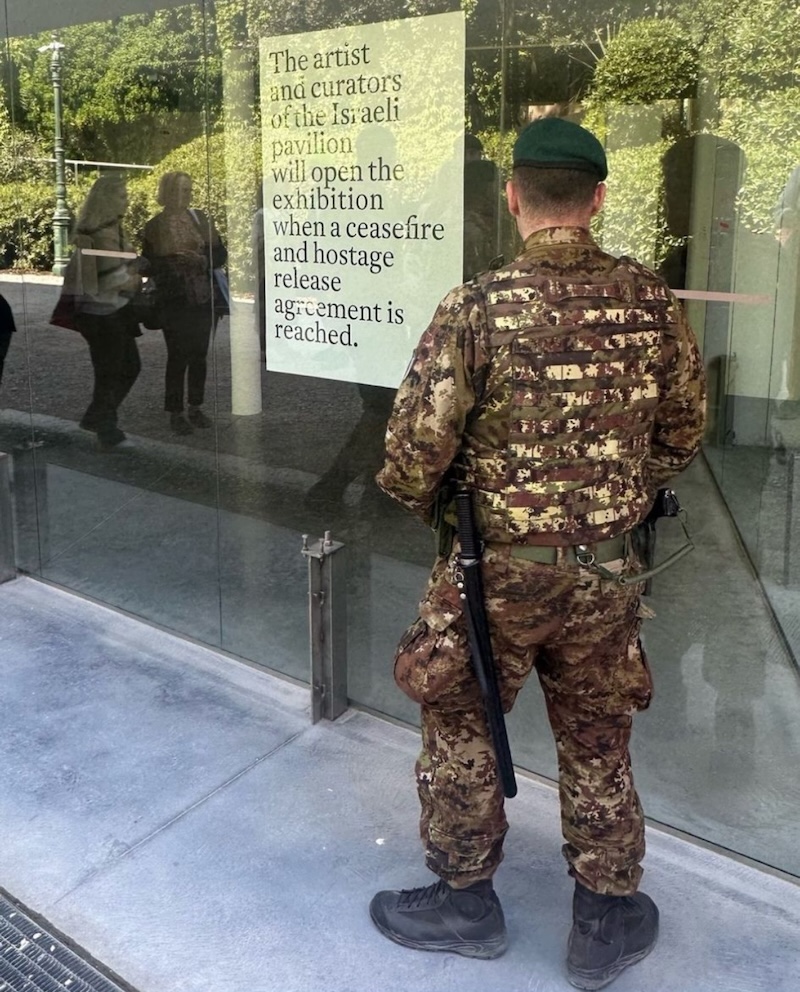
The Biennale’s decision to accommodate Israel’s pavilion in the Arsenale — its main venue alongside the Giardini — while Israel’s permanent Giardini pavilion is reportedly undergoing renovation has drawn particular ire. Critics have argued this is not a neutral administrative arrangement but an active choice by the institution to ensure Israel’s presence, and one that places it within the same physical space as the main curatorial exhibition, In Minor Keys. Three of the five curators chosen by the late Koyo Kouoh to carry out her vision for that exhibition signed the open letter demanding exclusion. The Biennale acknowledged their freedom of expression. It then proceeded unchanged.
In 2024, Israel’s pavilion was closed on its opening day by the artist herself, Ruth Patir, who said she would only reopen it when the hostages taken by Hamas were released and a ceasefire reached. Neither happened during the course of that edition. This year, Israeli artist Belu-Simion Fainaru will represent the country, and has objected strenuously to the jury’s decision not to consider his pavilion for prizes, describing it as discriminatory and based on “legally unstable and arbitrary” grounds.
The Jury Speaks — Partly
The response from within the Biennale’s own structure has been the jury statement, which represents the most concrete institutional action taken so far — and which has managed to inflame all sides simultaneously.
The five-member jury, led by Brazilian curator Solange Oliveira Farkas and including Elvira Dyangani Ose, Zoe Butt, Marta Kuzma and Giovanna Zapperi, announced that they would exclude from consideration for the Golden and Silver Lions “those countries whose leaders are currently charged with crimes against humanity by the International Criminal Court.” The statement did not name Israel or Russia directly, but its meaning was unambiguous: both Vladimir Putin and Benjamin Netanyahu carry active ICC arrest warrants.
The jury cited Koyo Kouoh’s curatorial vision as their inspiration — her mission to refuse “the spectacle of horror” and seek “the oases, the islands, where the dignity of all living beings is safeguarded.” It is a striking statement, and an unprecedented one in the Biennale’s history. The Biennale’s press office took pains to note that the jury acts with complete autonomy, implicitly distancing the institution from its own jury’s position.
The reactions came swiftly, and from every direction. ANGA praised the decision as a step forward and immediately noted that it was insufficient — pointing out that the jury’s statement conspicuously avoided naming Israel, and inviting the jurors to sign its own open letter calling for full exclusion. Pussy Riot founder Nadya Tolokonnikova called it “a good small step” while urging that there was still time to act more decisively. Israel’s foreign ministry, posting on X, accused the jury of having decided to “boycott” Belu-Simion Fainaru, the Romanian-born Israeli sculptor representing the country, calling it “a contamination of the art world.” The ministry’s statement declared that “the political jury has transformed the Biennale from an open artistic space of free, boundless ideas into a spectacle of false, anti-Israeli political indoctrination.” Fainaru himself was no less pointed, arguing that the jury’s decision “creates a hostile and degrading environment” imposed solely on the Israeli participant, and noting that other states with serious violations faced no such exclusion. The Biennale itself said nothing beyond affirming the jury’s autonomy. In all of this, the prizes have been rendered almost beside the point.
A History Marked with Conflicts
To treat 2026 as an aberration would be to misread the Biennale’s entire history. The national pavilion model — born at the end of nineteenth, and formalized through the early twentieth century — was always a stage for soft power, cultural competition, and geopolitical signalling. The Giardini, with its neat rows of national buildings in the architectural styles their builders wished the world to associate with them, is a map of the world order rendered in stone and mortar.
As Lawrence Alloway documents in The Venice Biennale, 1895-1968; from salon to goldfish bowl, the Biennale sustained itself through the fascist years with remarkable institutional continuity, its pavilion-based structure of national representation sitting, however uneasily, in alignment with the period’s prevailing nationalist ideology. The 1940 edition is a particularly striking case: opening in the shadow of a war already underway in Europe, it pressed forward as though the apparatus of international cultural exchange could be sustained even as the political or
der that underpinned it was collapsing. Alloway treats this moment not as an anomaly but as a symptom — evidence of how thoroughly the Biennale’s machinery had become detached from any genuine internationalism, operating instead as a diplomatic performance whose choreography continued out of institutional inertia as much as conviction.
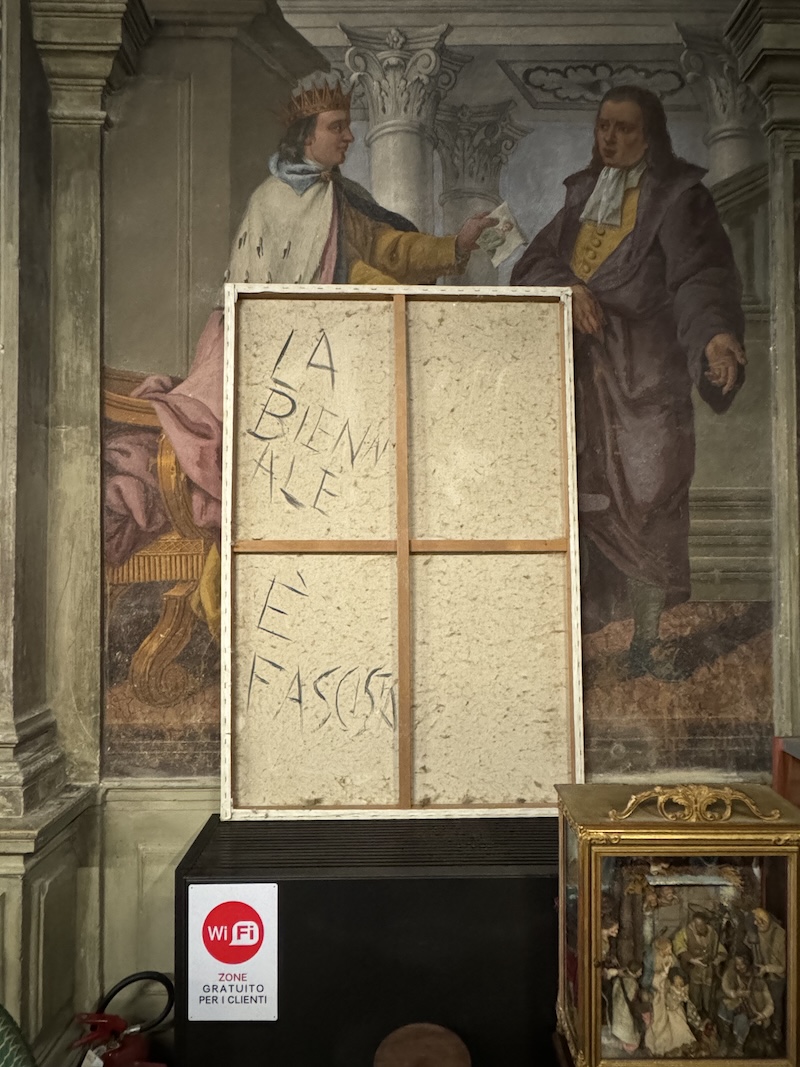
By 1968, the political pressures of that extraordinary year could not be contained. Students occupied the Venice Academy of Fine Arts, riot police filled the Giardini, and artists from multiple countries turned their canvases to the wall or closed their pavilions entirely. The Swedish pavilion posted a notice ending with the phrase “La Biennale è morta!” — “The Biennale is dead!” — which was promptly removed by a public official. Artists declared they would not be used, neither by the Biennale nor by the external forces pressing upon it. The awards were suspended. It was not the end of the Biennale. It was, arguably, its most honest edition.
In the aftermath, a new president, the socialist Carlo Ripa di Meana, briefly and radically reoriented the institution. The 1974 edition was dedicated entirely to Chile, in protest against the Pinochet dictatorship that had overthrown Salvador Allende the previous year. The 1977 edition took “dissent” as its theme. Then the pendulum swung back. The national pavilion model was retained, the Biennale professionalized, the prize structure restored. The politics did not disappear; they were absorbed back into the machinery.
In 1970, American artists mounted a large-scale boycott of the US pavilion over the Vietnam War, with activists attempting to reconceive it as a “Liberated Biennale.” In the Cold War years, the presence of American art — Abstract Expressionism in particular — was understood by all parties to be a cultural-political gesture, a demonstration of Western creative freedom against Soviet constraint. The Biennale has never not been political. It has merely, at certain periods, been successful at not appearing so.
The Myth of Institutional Neutrality
The institution’s consistent retreat to the language of neutrality — “artistic freedom,” “open institution,” “no censorship” — is not without a logic. The Biennale brings together artists from over 100 nations; any principle of exclusion is liable to be inconsistently applied, and there are genuine questions about whether artists should be penalized for the actions of governments they did not choose and may actively oppose. These are serious concerns.
But the argument for institutional neutrality has a cost that is rarely named directly: it distributes the benefits of prestige equally between states regardless of what those states are doing. When the Biennale extends the legitimacy of the world’s most prestigious contemporary art exhibition to a nation actively engaged in the bombing of civilian infrastructure and the destruction of cultural heritage, it is not standing apart from those conflicts. It is participating in them, on one side.
The Biennale’s own jury, inspired by the vision of Koyo Kouoh — the first African woman appointed to lead the main exhibition, who died before she could see her work realized — has said as much in its extraordinary, cautious, partial statement. Three of her curators said as much when they signed the open letter. Two hundred artists said as much when they added their names. The officials from Finland and Latvia said as much when they declined to attend the opening. The European Commission said as much when it threatened to close its wallet.
The institution, for its part, has answered each of these interventions with procedural calm. This is, in the end, its own kind of statement.
In Minor Keys — Kouoh’s chosen theme, carried forward after her death by the team she had gathered around her — was always about what gets muted: the quiet voices, the marginal dignities, the things the grand machinery of institutions tends to drown out. It is a beautiful and melancholy irony that the edition bearing that title has so far generated more noise, more furore, more international diplomatic incident than almost any other in the Biennale’s 131-year history. The minor keys turned out to be the ones everyone is listening for.