

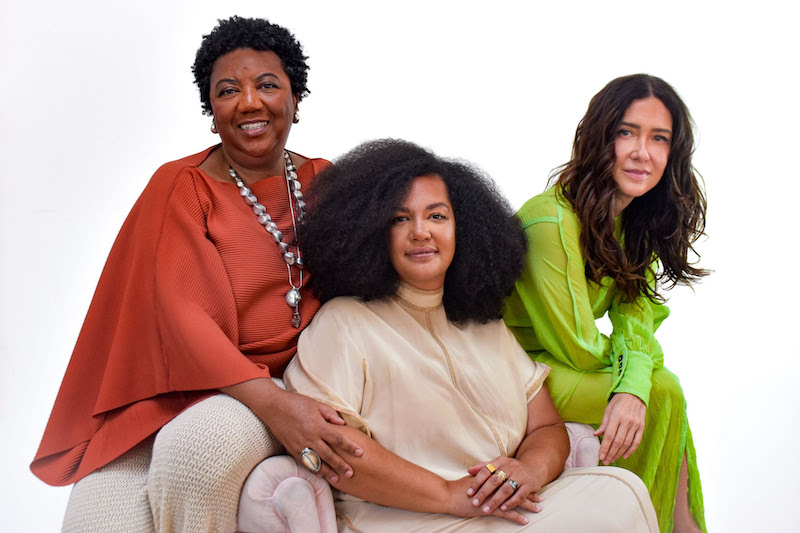
The Fundação Bienal de São Paulo announces the curatorial project for the Brazilian Pavilion at the 61st International Venice Biennale, carried out in partnership with the Ministry of Culture and the Ministry of Foreign Affairs. The exhibition is presented by Petrobras.
Entitled Comigo ninguém pode, the exhibition is curated by Diane Lima and brings together, in an unprecedented dialogue, artists Rosana Paulino (São Paulo, 1967) and Adriana Varejão (Rio de Janeiro, 1964), who will occupy the entire Brazilian Pavilion starting in May 2026. The exhibition takes an installation-based approach that challenges the modern architecture of the building.
Taking as its starting point and state of mind the syncretic and ambiguous characteristics of the plant popularly known as comigo-ninguém-pode, a species that, due to its toxicity, has become a symbol of protection and resilience, the project invites the public to a sensitive experience that proposes new ways of perceiving the relationships between nature, history, and spirituality.
Breaking with the linearity of time, the exhibition brings together historical works from more than three decades of production by the two artists, in which both address colonial wounds and traumas, while highlighting how this rewriting of history also manifests itself through processes of metamorphosis and dialogue with the performance of materialities in space.
Comigo ninguém pode comes from the Portuguese name for the plant known in English as dumb cane or leopard lily (Dieffenbachia), a species widely used in front of houses or doors in Brazil as a symbol of spiritual protection and ancestral resilience. The ambiguity and syncretism of the term, which also became a popular saying, can be understood as “Nobody can handle me”, “Nobody can defeat me,” or even “Don’t mess with me!”, a meaning that alludes to the plant’s toxicity and poison.
The title also refers to a drawing from Paulino’s Senhora das plantas [Lady of the Plants] series. In addition, Varejão uses painting to simulate different materialities, such as concrete, flesh, Baroque woodcarving, and ceramics, culminating in the botanical element. “The project invites us to connect to a frequency that opens up the possibility of seeing the transcendent in the visible. By evoking this energy, Comigo ninguém pode reflects on the manifestations of faith and spirituality in Brazilian culture, highlighting its close relationship with nature, with more-than-human dimensions and, above all, in the construction of a complex public imagination. These elements constitute everyday practices that allow us to glimpse a reality that is sometimes broader or deeper than what we perceive in the visible world. By rewriting history, Comigo ninguém pode reconstructs the walls of memory and assigns new meanings to colonial ruins and wounds through fantastic, celestial, and magical beings”, says Diane Lima.
“In works such as Aracnes and Ninfa tecendo o casulo [Nymph Weaving a Cocoon], I return to the image of the Black woman as a weaver of life and memory, one who draws from her own body the material to sustain continuity. These are works that affirm the strength of reconstruction, of suture, and of permanence in the face of historical violence”, says Paulino.
“I am working intensely on many new works for the Pavilion, conceived in direct dialogue with the building’s architecture. The paintings are distributed in unpredictable ways throughout the space, taking on an installation-like character and making the building an active part of the work”, says Varejão.
The curatorial approach was designed to emphasize the dialogues that run through the prolific careers of both artists. The exhibition brings together historical, and previously unseen paintings, sculptures, and drawings, as well as new large-scale works developed especially for this encounter. The works were chosen based on overlaps, tensions, and symbolic, chromatic, material, and iconographic similarities that constitute this historical and cultural national repertoire.
“From the moment the idea of inviting Rosana and Adriana arose, my biggest challenge was to present them as a composition, a single voice, full of harmonies and dissonances, so that this gesture and our own presence would have, as in jazz, a much more performative and sensory dimension than a didactic one about our history. I believe that Brazil will see itself as a reflection and a shadow in the mirror, a self-portrait painted with conversations about flesh, nature, and faith”, adds Diane Lima.
“Diane Lima’s curatorship and the meeting of Adriana Varejão and Rosana Paulino consolidate a celebrated project for Brazil’s presence in Venice. It is a proposal that underpins our institutional commitment to consistent, contemporary participation that is connected to the global debate”, says Andrea Pinheiro, president of the Fundação Bienal de São Paulo.
Recovery of the Brazilian Pavilion
The Brazilian Pavilion, designed by Giancarlo Palanti, Henrique Mindlin, and Walmyr Lima Amaral in 1964, was recovered by the Fundação Bienal de São Paulo in partnership with the Ministry of Culture and the Ministry of Foreign Affairs. The process took place in three phases: the first focused on essential structural repairs; the second recovered key elements of the original architectural design, most notably the lateral glass walls and the Pavilion’s façade; and the final phase was completed in early 2026.
Brazilian Pavilion at the 61st International Art Exhibition—the Venice Biennale: Comigo ninguém pode
Commissioner: Andrea Pinheiro, President of the Fundação Bienal de São Paulo / Curator: Diane Lima / Participants: Adriana Varejão and Rosana Paulino / Exhibition design: Daniela Thomas / Curatorial assistant: Giovanna Querido / Location: Brazilian Pavilion / Address: Giardini Napoleonici di Castello, Padiglione Brasile, 30122, Venice, Italy / Date: May 9 to November 22, 2026
Photo: Igor Furtado.