
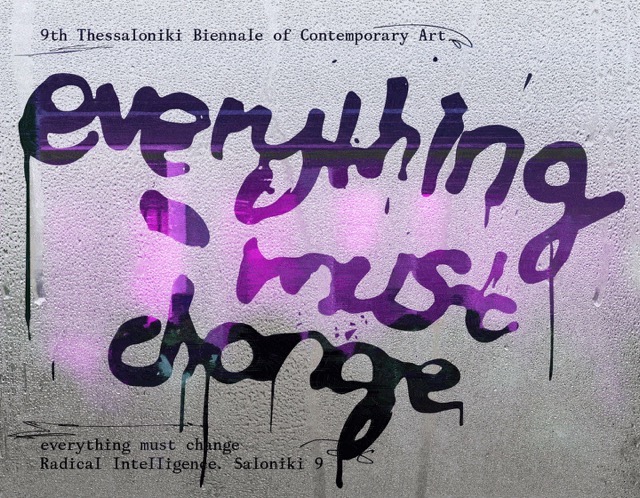
With the ambiguous title, everything must change. RIS9, the 9th Thessaloniki Biennale of Contemporary Art is organized by MOMUS and curated by independent curator Nadja Argyropoulou.
It engages with a common (place, urgent demand that can feel like a revolutionary cry and echo like an empty slogan, ring like a rage bait and work like a charm. It is a phrase that is wielded by social revolutionaries and techno-feudalists alike, by persecuted activists and fascist-adjacent demagogues, by countercultures and institutional propaganda.
Through its shared utterances, visual frequencies and f(r)ictions; through its peripheral place and minor scale in the artworld, Biennale 9 employs a mode of close narration and is marked by what it proposes.
As its curator notes, “this ninth edition is cast as a para-biennale that acknowledges paradoxes of enclosure and escape, takes pleasure in errant paths, and sides with tactics of joyful militancy. If indeed, “in the face of new tyrannies encroaching, we should use art not to ask questions but to give audacious answers that nobody asked for” (as per Luce deLire), Βiennale 9 enters by flipping questions, experimenting with an anarchy of answers, refusing the proper and the proposed.
It takes a bold stance on the power of imagination, suggests a kind of intelligence that is radical (the shorthand “RI’) and sides with a non-fascist AI (as per Dan McQuillan) that does not reproduce forms of dominance but supports autonomy and freedom based on collective activity.
If new solidarities and vocabularies, a “social otherwise,” need to be crafted in order to change life shaped by genocidal capitalism and the tools cannot be those of the master’s own, then Biennale 9 chooses to be inspired by Saidiya Hartman’s method of “critical fabulation” and take recourse to waywardness as “the social poesis that sustains the dispossessed.”
It is made by works that explore un-settling paths and divergent stories, ways to speak truth to power; works that suggest when to rant and how to whisper, when to laugh and how to love. If “the revolution is like housework—you have to do it every day” (G. C. Spivak)—then everything must change. RIS9 wishes to be part of this every day and attempt a bewildering proposition.”
The shorthand “S9” evokes a popular, older, eastern in origin, name of Thessaloniki (Saloniki), thereby inserting in the Biennale’s utterance a double movement, towards and away from the city.
After a prelude last Fall around the revolutionary potential of science fiction and through a host of interim cooperations and manifestations, the Biennale will realize its main exhibition between May 23 and July 5, 2026.
Its hosting venues co-create a crucial space of (d)rift:
–Buildings within the Thessaloniki International Fair–Helexpo complex, including the Museum of Contemporary Art, that highlight the site’s ties to modern Greece’s foundational socio-economic narratives and political ceremonies since the 1960s, as well as its current significance as the battleground of competing plans around the function and future of public space.
–The Kalochori Lagoon on Thessaloniki’s western outskirts, a landscape shaped by immigrant communities, industrial growth, and the gradual emergence of a wetland as a result of land subsidence, groundwater depletion, and the mixing of river and sea waters. Now part of the Axios Delta National Park, the lagoon is rich in rare biodiversity and participates in contradictory narratives of “symbiotic living” as the city inexorably expands to this side.
Photo: Courtesy of the Thessaloniki Biennale of Contemporary Art.