

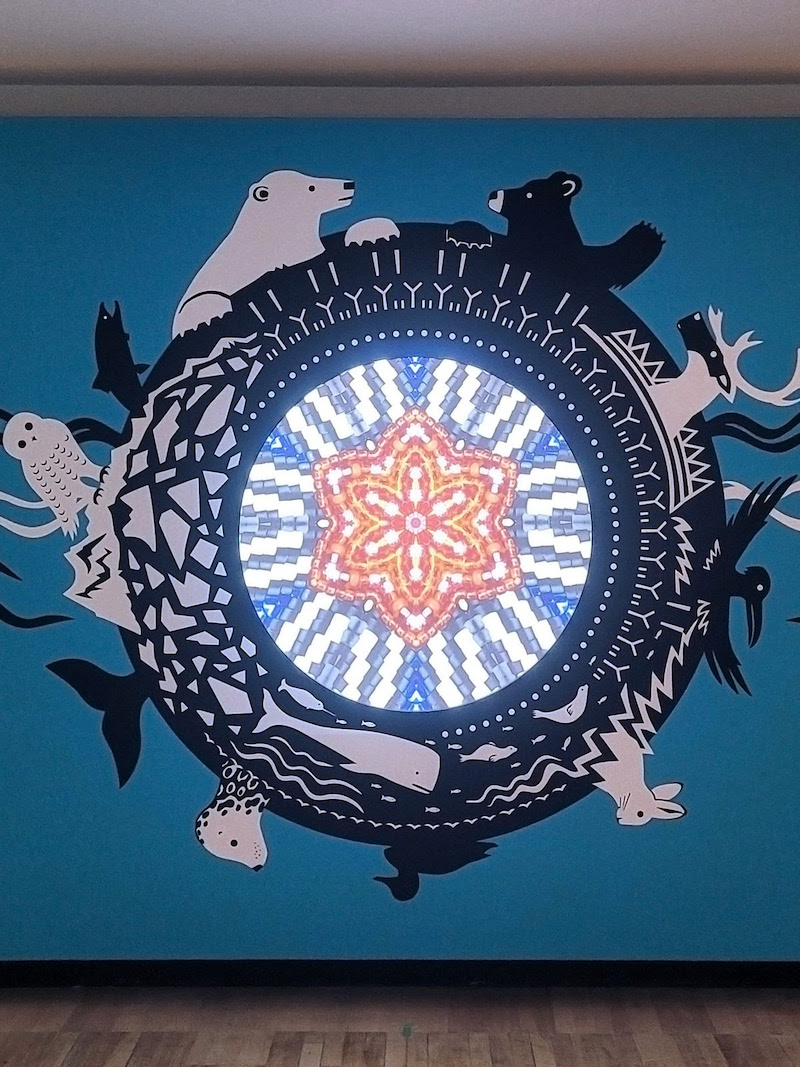
Briser la glace / Splitting Ice
Manif d’art 12—The Quebec City Biennial
February 28–April 19, 2026
Espace Quatre Cents
100 Quai Saint-André
Quebec, QC G1K 3Y2, Canada
Manif d’art – La Biennale de Québec returns for its 12th edition under the curatorial direction of Didier Morelli. Titled Briser la glace / Splitting Ice, the biennial unfolds across Québec City and Lévis, engaging winter not as backdrop but as material condition, territorial reality, and political framework.
As the only winter contemporary art biennial in North America, Manif d’art operates within a northern climate that is both environmental and infrastructural. Ice, snow, freeze–thaw cycles, reduced daylight, and subzero temperatures are not metaphors here; they are working conditions. They shape logistics, production schedules, installation methods, and audience circulation. Winter becomes an active collaborator.
This edition stands out for its emphasis on production. Thirty-five percent of the works presented are newly commissioned, conceived specifically for this context. The biennial is positioned not merely as a site of exhibition but as a site of fabrication, experimentation, and risk. Artists developed projects in dialogue with Québec’s winter territory—its riverbanks, public spaces, urban surroundings, and northern imaginaries. Several performances and installations are site-specific, responding directly to the climatic conditions of late winter.
Producing art under winter constraints entails distinct challenges: material resistance in extreme cold, transport limitations, condensation, structural adaptation, and ecological responsibility in fragile environments. Rather than neutralizing these constraints, the biennial foregrounds them. Production becomes an inquiry into resilience, temporality, and environmental negotiation.
The territorial dimension of Briser la glace / Splitting Ice extends beyond geography. The St. Lawrence River, frozen and shifting, operates as both symbol and infrastructure—an artery historically tied to trade, colonization, extraction, and mobility. Ice, here, marks thresholds: between mobility and immobility, sovereignty and permeability, stability and transformation. The biennial situates contemporary art production within this layered terrain of climate, history, and governance.
Indigenous perspectives are central to this edition. Twenty-one percent of participating artists are Indigenous, representing Canadian First Nations, Inuit, Métis, Sámi, Maya, Atayal, and other communities. Their works address territory as lived continuity, ecological stewardship, memory, and resistance. In the context of accelerating climate transformation, these artistic positions complicate dominant narratives of environmental crisis by foregrounding relational and land-based epistemologies.
The biennial also includes a dedicated Young Curators program, offering emerging curators the opportunity to organize exhibitions in collaboration with artists and local institutions. This initiative reinforces Manif d’art’s commitment to generational transmission and to sustaining contemporary art ecosystems within Québec.
Institutional partnerships support this production-oriented model. Collaborations with major cultural organizations—including national institutions and regional partners—enable the realization of ambitious commissions in both indoor and outdoor contexts. Among these, the performance work of Sylvie Tourangeau is presented by the National Gallery of Canada as part of its National Outreach Initiative, with additional funding provided by the National Gallery of Canada Foundation. These partnerships extend the biennial’s territorial footprint while reinforcing its local anchoring.
By foregrounding newly commissioned works and site-specific interventions within a northern climatic context, Briser la glace / Splitting Ice advances a model of the biennial as a generator of contemporary art rather than a platform of circulation alone. Production here is not secondary to exhibition; it is the core mechanism through which territory, climate, and art practice intersect. In an era defined by environmental instability and shifting geopolitical landscapes, Manif d’art affirms the biennial as a space where art is made under pressure, in real time, within the material realities of winter.
About the Québec City Biennial
One of the largest contemporary art biennials in the country, Manif d’art—The Québec City Biennial is the only event of its kind in North America to take place in winter. Since the first Manif in 2000, more than 50 cultural organizations have helped shape it into a must-see cultural event for both curious first-timers and art enthusiasts.
About the curator
Didier Morelli is a curator, art historian, cultural critic, and interdisciplinary artist. He is a Scholar-in-Residence in the Curatorial Studies and Practices program at Concordia University and holds a postdoctoral fellowship from the Fonds de recherche du Québec—Société et culture, shared between Concordia University and the Canadian Centre for Architecture. His writing has been published in Art Journal, Canadian Theatre Review, C Magazine, CBC Arts, Esse, Spirale, and The Drama Review, among others.
Photo: Glenn Gear.